AI Audit: The Three Questions Your Auditor Will Ask (And How to Have Them Ready)
An AI audit doesn't ask about technology: it asks who can stop the system, what happens if the control fails, and where it's written down what it's allowed to do. Here are the three answers you need in writing.

TL;DR: An AI audit doesn't open with a question about technology. It opens with who can stop the system, what happens if the control fails, and where it's written down what the AI is allowed to do. If you can't answer those three questions in writing, you don't have a system — you have an experiment running in production.
What does the EU AI Act mean by human oversight?
When the European AI Act — the EU AI Act — talks about human oversight, it isn't asking you to post someone in front of a screen "just in case."
It's asking for something much more concrete, set out in Article 14 of the regulation: a person with the competence and the authority to understand what the system is doing, to detect when it's behaving abnormally, and — above all — to decide not to use it, to override its output, or to shut it down completely, at any moment.
Think of it as the pilot and the autopilot. The autopilot flies the plane for most of the journey, but there's a pilot with hands near the controls who can switch it off the second something doesn't add up. Without that pilot, you don't have automation — you have a plane with no one in charge.
What are guardrails, and why does the regulation ask for them?
Guardrails — the hard limits that define what an AI system can and cannot do, no matter what — are the other half of the equation.
The analogy is the barrier on a mountain curve. It's not there to make you drive slower. It's there for the day something goes wrong and you need the car not to end up in the ravine. A well-designed guardrail doesn't stop the AI from working; it stops a mistake from reaching a customer, sensitive data, or a decision the system was never supposed to make on its own.
The regulation turns this into two very practical obligations for higher-risk systems: the capacity to log what the system did and when (Article 12 — what was checked, against what data, who verified the result), and technical documentation that clearly explains what the system does, what it's meant for, and where its limits are (Article 11).
The three questions an AI audit will ask you
Put the two pieces together and you land on the real audit — the one that doesn't stay in theory:
- Who can stop this? Not as a nice phrase: a name, a role, and real authority to disconnect the system without asking anyone else for permission.
- What happens if the control fails? What occurs if the person supervising doesn't catch the failure in time, and what safety net exists underneath that one.
- Where is it written down what the system is allowed to do? Not in the head of whoever built it — in a document that survives that person leaving the company.
If those three answers exist, showing them to the auditor takes ten minutes. If they don't, you're improvising them in front of him, which is the worst possible position to be in.
The typical mistake: reading the regulation only for the fines
The most common reading of the EU AI Act stops at the table of penalties. That's a mistake, and not just because it's the wrong kind of fear.
The same three answers an auditor asks for are the ones you need to have written down anyway, regulation or not, for the day an AI agent makes a decision it shouldn't have made. The difference between a company that resolves that incident in an afternoon and one that spends three weeks in crisis isn't the technology — it's whether those answers were already on paper before anyone needed them.
Read that way, the regulation isn't only the part that fines you. It's also the part that forces you to document something you were going to need to document for yourself sooner or later.
When does this apply, and to whom?
The EU AI Act applies generally from 2 August 2026. For higher-risk systems under Annex III, the deadline extends to 2 December 2027, and for those embedded in already-regulated products (Annex I), to 2 August 2028.
Most SME automations — an agent that handles customer service, qualifies leads, or supports a sales team — don't fall into the high-risk category. But the auditor's three questions don't lose their point because of that: they're good practice with or without the regulation, and it's far cheaper to answer them before you build the system than after it fails.
Who answers these questions for you
Building an AI agent without these three answers in writing means leaving governance for later — and "later" almost always arrives in the shape of an incident. Digital Transformations' Digital Teams Guide walks you through, step by step, how to set up a digital team with real human oversight built in from the design stage, not bolted on at the end.
Download it and have these three answers written down before an auditor, a customer, or worse, a real failure asks you for them.
https://www.digitransformations.com/guia-equipos-digitales
Content developed with AI assistance and reviewed by the Digital Transformations editorial team
Frequently asked questions
What does human oversight mean under the EU AI Act?
It's the real ability of a competent person to understand, detect failures in, and stop a high-risk AI system at any moment, as required by Article 14 of the regulation.
What are guardrails in an AI system?
They are the hard limits that define what the system can and cannot do, so that a mistake never reaches a customer or sensitive data.
Does my SME have to comply with the EU AI Act?
It depends on the system's risk level. The regulation applies generally from 2 August 2026, with extended deadlines to 2027 and 2028 for higher-risk cases; even without being high-risk, documenting oversight and limits is good practice.
What documentation does the regulation require for high-risk systems?
A usage log (Article 12) and technical documentation explaining how the system works, what it's for, and its limits (Article 11).
What happens if I don't have these answers in writing?
You don't have a controlled system — you have an experiment running in production, with the financial and reputational risk that carries if something fails or gets audited.
Related articles

What Breaks When You Connect More Than One AI System
A single AI agent is easy to watch over. The moment you connect a second one, three failures appear that didn't exist before. Here's what they are and how to fix them.
The Three Levels of AI Autonomy (and How to Choose the Right One)
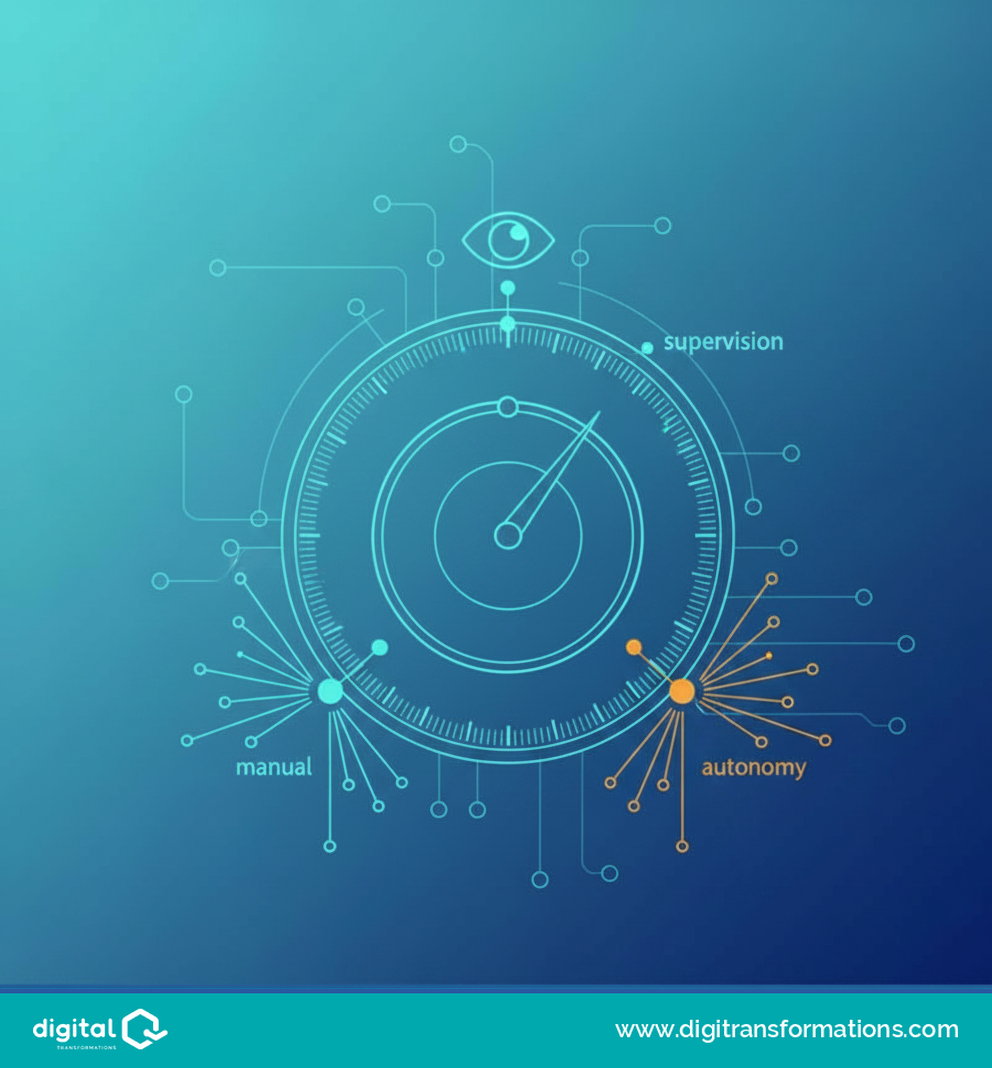
AI autonomy isn't a switch, it's a dial. Here are the three levels that exist and how to choose the one your business actually needs.

Hiding is not blocking: why hiding a button does not protect your data
If a user cannot see something, that does not mean they cannot reach it. Three real cases of controls that looked in place and were not.